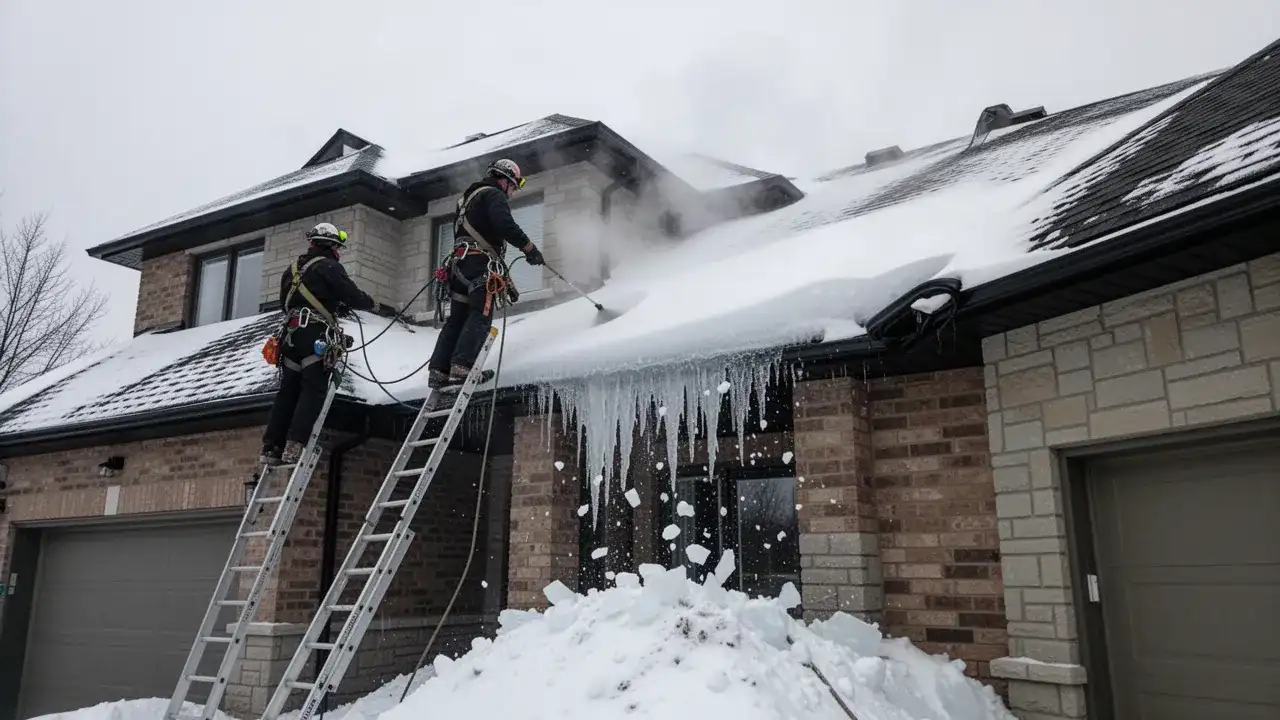
Roofers steaming ice dam off Burlington home eaves
Residential roofing

Ice Dam Removal and Roof Snow Removal in Burlington, ON

Ice dam removal in Burlington starts with a simple fact: the ridge of ice on your eaves is a symptom of heat escaping from the house, not a shingle defect. Fixall Roofing clears ice dams with low-pressure steam, takes snow off roofs that are carrying too much, and then tracks down the attic problem that created the ice in the first place.

That makes it roofing work rather than snow clearing. As a Burlington roofing contractor, we deal with both sides of the deck: the frozen eave outside and the warm attic air behind it.

Homeowners usually reach out for one of three reasons: water dripping through a ceiling during a thaw, eaves loaded with thick ice and icicles, or the same ice dams returning for another winter. Every visit ends with clear advice on ice dam prevention, so you are not paying for removal every February.

  • 15+ years experience
  • 700+ jobs completed
  • Fully insured + WSIB
  • Working at Heights certified
  • 1-year labour warranty
  • Open 24/7

Ice Dam Removal and Roof Snow Clearing, Start to Finish

Winter roof calls rarely involve just one task. A typical visit combines steaming drainage channels through the ice, clearing snow from the lower edge of the roof, and checking the attic for the heat leak behind it.

We work on detached homes, townhouses and low-rise commercial buildings across Burlington and the towns within about a 30 minute drive. Our phone line is answered 24/7, so a leak that starts at midnight during a thaw can be logged and scheduled right away.

  • Low-pressure steam ice dam removal on shingle, metal and flat roofs
  • Roof snow removal from eaves, valleys and low-slope sections
  • Thawing frozen eavestroughs and downspouts so meltwater can drain
  • Temporary leak control when water is already inside
  • Attic checks and prevention upgrades once the weather allows

What Causes Ice Dams on Burlington Homes

An ice dam forms when the upper roof is warmer than the eaves. Heat leaking from the house warms the roof deck, snow melts from underneath, and the water runs down until it reaches the overhang, which sits outside the heated walls and stays below freezing.

There the water refreezes into a ridge of ice. Each melt adds to the ridge, until water pools behind it and works its way up under shingles that were designed to shed water, not hold it back.

Lakeshore neighbourhoods in Burlington see frequent swings above and below freezing through the winter, so the melt and refreeze cycle can repeat many times in one season. Homes above the Niagara Escarpment, in north Burlington and toward Waterdown, often hold deeper snow on the roof for longer, which gives a dam more water to work with.

House design plays a part too. Low-slope sections, valleys that empty onto an eave, dormers, and 1.5 storey homes with knee walls and sloped ceilings tend to dam first, because heat escapes close to the roof surface.

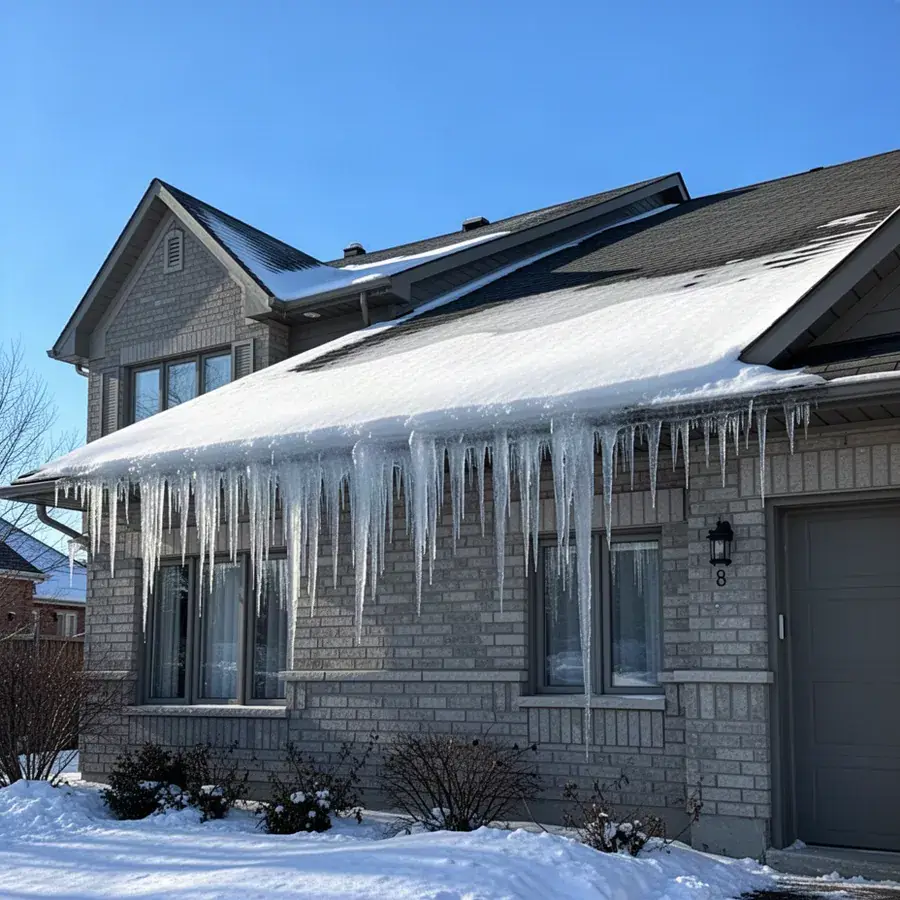
Thick ice dam and icicles on Burlington roof edge

How We Remove Ice Dams Safely

We use a commercial steamer that delivers very hot steam at low pressure. The wand melts through ice like a hot knife, so we can open drainage channels and lift away blocks of ice without striking the shingles.

Steam melts ice instead of breaking it, and the pressure stays low enough that it does not strip granules off asphalt shingles or drive water under the laps. That is the key difference between professional removal and the methods that cause most of the damage we repair.

Axes, chisels and hammers crack shingles, which are brittle in the cold, and punch holes through the underlayment beneath them. Pressure washers cut through ice but also cut into the shingle surface, while dumping more water onto a roof that is already struggling to drain.

Rock salt and calcium chloride pucks are no better. They corrode metal flashing and eavestroughs, damage plants below the eaves and leave most of the ice in place.

On site, we open the downspouts and eavestrough outlets first so the meltwater has somewhere to go. We then cut channels through the dam to relieve the backed-up water, and remove the rest of the ice if you want the eaves fully cleared.

Channel cutting is faster and costs less, while full removal takes longer but leaves nothing to refreeze. Our crew works from secured ladders and fall arrest equipment set up to Ontario Regulation 213/91, with Working at Heights training under Ontario Regulation 297/13.
Snow Removal for Flat and Low-Slope Roofs

Most pitched residential roofs in Burlington are framed to carry normal winter snow without help. Flat and low-slope roofs are different: snow does not slide off, drifts build against parapets and taller walls, and rain falling into deep snow adds weight quickly.

Warning signs of an overloaded roof include interior doors that suddenly stick, fresh cracks in drywall near the ceiling, creaking in the structure and visible sag in a ceiling. If you notice any of these, keep people out of the space below and call us.

We clear snow by hand with plastic shovels and roof rakes, never metal blades or snowblowers on the surface. The crew deliberately leaves a few centimetres of snow as a protective base, so tools never touch the EPDM, TPO, modified bitumen or shingles underneath.

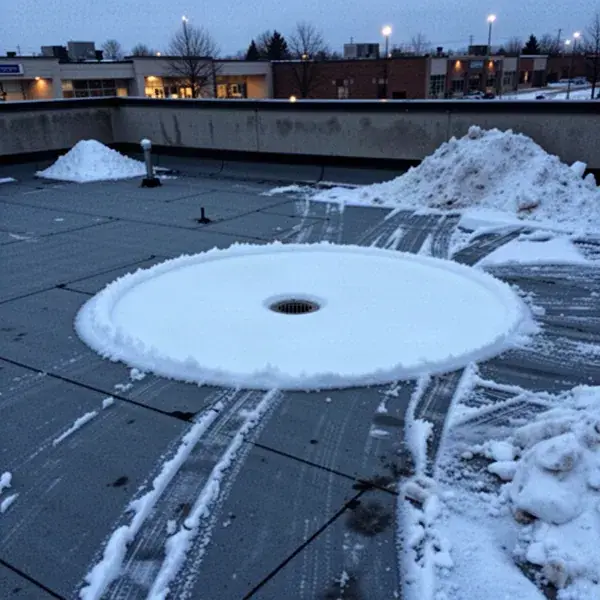
Drains, scuppers and the paths leading to them are cleared first, because a buried drain turns the next thaw into ponding. We also control where the snow lands, keeping it away from walkways, gas meters, exhaust vents and parked cars.

On larger commercial roofs we remove snow in a balanced pattern. Heavily clearing one side while the other stays loaded can stress the framing unevenly.

Snow cleared around flat roof drain in Burlington

Preventing Ice Dams for Good

Removal solves this winter's problem. The fixes below are ranked by how much they reduce the chance of ice dams coming back, starting with the biggest impact.

Air Sealing and Attic Insulation

Most of the heat that melts roof snow reaches the attic through air leaks rather than through the insulation itself. Gaps around pot lights, plumbing stacks, wall top plates and the attic hatch let warm, moist air rise straight under the deck.

Sealing those gaps and then bringing the insulation up to depth keeps the roof close to outdoor temperature. Our attic insulation service covers both steps in that order.

Balanced Attic Ventilation

Ventilation carries away whatever heat still reaches the attic. Cold air should enter at the soffits, travel up under the roof deck and leave through a ridge vent or high exhaust vents.

When intake is blocked or exhaust is undersized, warm air lingers under the upper roof and keeps melting snow. We assess and correct both sides through our roof ventilation work.

Ice and Water Shield at the Eaves

A self-adhered membrane such as Grace Ice & Water Shield bonds to the deck and seals around every nail. If ice does back water up, the membrane keeps it out of the house.

The Ontario Building Code (Section 9.26.5) calls for eave protection running at least 900 mm up the slope and at least 300 mm past the inside face of the exterior wall. On homes with chronic ice dams we often run it higher, and it is installed as standard with every asphalt shingle roof we put on.

Heat Cables: Where They Help and Where They Do Not

Self-regulating heat cable laid in a zigzag along the eave, and run through the eavestrough and downspout, can hold a drainage path open on a stubborn valley or north-facing eave. It earns its place where the house design makes a problem spot hard to fix any other way.

Cable does not stop the heat loss that makes the meltwater, and it uses electricity every hour it runs. Poorly fastened clips can also damage shingles, so we treat cable as a targeted backup rather than a cure.

The roof edge matters as well, because eavestroughs packed with frozen leaves give meltwater nowhere to go. Well-chosen gutter guards keep debris out, although some styles can ice over, so we match the product to your roof edge and exposure.

Ice Dam Leaks Inside the House

Water from an ice dam usually appears along exterior walls: stains at the ceiling line, drips from the top of a window or from pot lights near the eaves, or bubbling paint. It often starts during a mild spell or a sunny afternoon, when melting peaks.

First, protect the house. Move furniture and electronics, put down buckets and towels, and if water is near a light fixture, switch that circuit off at the panel.

Do not climb onto an icy roof or chip at the dam from a ladder. Call our 24/7 line instead, and we can steam a relief channel and handle any emergency roof repair needed to stop water getting in.

Photograph the damage before cleanup in case you need it for an insurance claim. Soaked attic insulation loses much of its value and can feed mould if it stays damp, so we check it while we are on site.

Ice Dam FAQs

Should I knock icicles off my eavestroughs?

Large icicles are heavy enough to injure someone or tear an eavestrough off its hangers when they fall, so leaving them is not risk-free either. If you remove them, work from the ground with a long tool, stand well clear and never strike the eavestrough itself. Big icicles are also a sign that heat is escaping into the attic, which is worth mentioning when you book an inspection.

Is it safe to use a roof rake?

Yes, if you use it from the ground, pull gently and leave a few centimetres of snow on the shingles. Scraping right down to the surface strips granules and can catch shingle edges. Stay well clear of power lines, especially with an aluminum rake, and never use one from a ladder.

How much does ice dam removal cost?

Steam ice dam removal is usually billed by the hour, and as a general estimate rates in the Burlington, Hamilton and Halton area commonly fall in roughly the $350 to $600 per hour range, often with a two to three hour minimum. The total depends on the length and thickness of the dams, roof height and pitch, access and whether snow has to be cleared first. We confirm the rate before the crew starts, and prevention work is quoted separately after an attic assessment.

Request a quote

Book Ice Dam Removal or a Prevention Check

If water is coming in now, call us any time of day or night and we will schedule steam removal as quickly as crews and conditions allow. For prevention, book an attic and roof edge assessment and we will explain what is causing your ice dams and what each fix would cost.

Removal and repair labour carries our 1-year labour warranty, and membranes, vents or insulation we install are covered by their manufacturers' warranties.

Phones answered 24/7, including emergencies.

  1. 1We call you back to confirm the details.
  2. 2We inspect the roof and attic and take photos.
  3. 3You get a written scope and price. No pressure.
Call 289-816-1772Get a Quote