Maple Keys
The winged seeds slip through screens and wedge upright in large openings. Micro-mesh or fine perforated aluminum stops them completely.
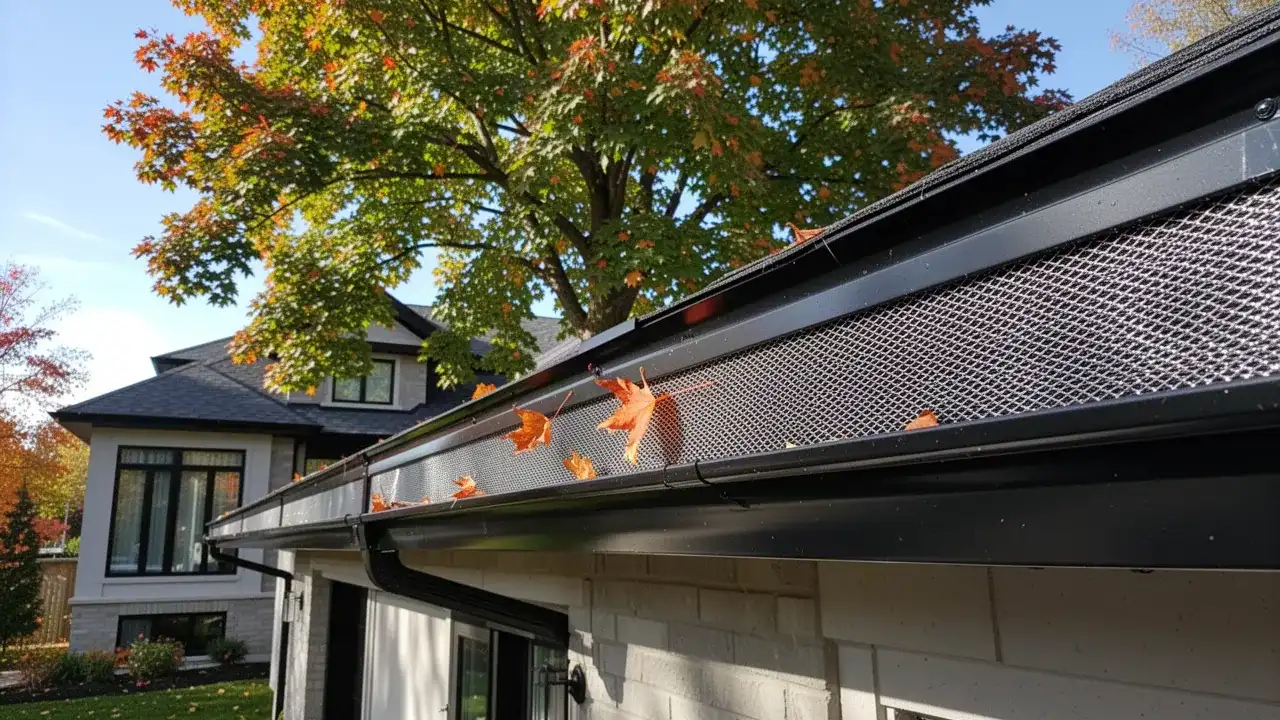
Gutter guards in Burlington earn their cost on lots with mature trees, and Fixall Roofing, a Burlington roofing contractor, installs them to cut down on ladder cleaning and stop overflow without harming your roof. We match the guard to the debris that actually lands on your roof, whether that is maple keys, oak leaves or pine needles.
Guards are often fitted by crews who are not roofers, and the shingle edge is usually what pays for it. We treat a guard as part of the roof edge, so the shingles and drip edge come first and the guard is fitted around them.
We serve homeowners across Burlington and nearby Halton and Hamilton communities. If your trees are far enough away that guards are not worth it, we will tell you that too.
Guards cover the trough, so anything wrong underneath gets sealed in. That is why most of our process happens before the first guard goes on.
We note which trees overhang which walls, how much debris they drop and how the shingles, drip edge and troughs meet at the eaves. Most homes are finished in one day.
Based on your debris and trough profile, we recommend a guard type and explain what it will and will not stop.
Every trough and downspout is cleaned by hand and flushed, so you start with a clear system under the new guards.
Leaking corners, loose hangers and flat spots are handled before covering them, using the same methods as our eavestrough repair service.
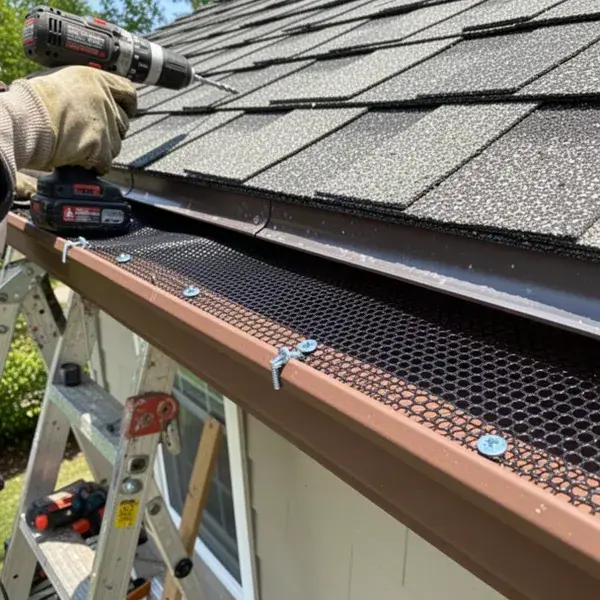
Guards are screwed to the front lip of the trough and fitted at the back without nails through shingles, with corners and end caps trimmed to close gaps.
We run water over the guards at the steepest roof sections and valleys to confirm it enters the trough instead of sheeting over the front.
Every guard is a trade-off between how much it blocks, how fast water gets through and how easily it can be cleaned. Cost tiers are relative to each other for supply and installation.
| Type | What It Blocks | Maintenance | Cost Tier |
|---|---|---|---|
| Stainless micro-mesh | Leaves, seeds, needles, most grit | Brush the surface yearly | Highest |
| Perforated aluminum | Leaves and maple keys | Brush or blow off yearly | Moderate |
| Plastic or steel screens | Large leaves only | Frequent, seeds wedge in | Low |
| Reverse-curve hoods | Large leaves | Nose slot clogs, overflows in downpours | Moderate to high |
| Foam and brush inserts | Large leaves | Pull out and clean, seeds sprout | Lowest |
For most Burlington homes we recommend stainless micro-mesh or a quality perforated aluminum guard. Both handle maple keys, which defeat basic screens, and both can be cleaned without removing them.
We rarely recommend foam or brush inserts. They fill with fine debris, hold moisture against the trough and become planters for maple seedlings within a couple of seasons.
Guards also need a sound trough to clip onto. On old sectional troughs held up with spikes, or troughs too small for the roof, we may suggest new seamless eavestroughs first, since guards slightly reduce how fast water can enter an undersized trough.
Burlington's older streets in areas such as Roseland, Shoreacres and Tyandaga are lined with mature maples and oaks, while newer subdivisions get more needles and seed pods from young plantings and neighbouring evergreens. The debris decides the guard.
The winged seeds slip through screens and wedge upright in large openings. Micro-mesh or fine perforated aluminum stops them completely.
Large leaves are easy for any guard, but the stringy spring catkins mat on top. Guards installed at roof pitch shed them better than flat ones.
Needles slide through perforated metal and screens. Only stainless micro-mesh with a fine weave keeps them out reliably.
Granules wash off every asphalt roof and pass through most guards. They settle as grit in the trough and downspouts, which is why guarded systems still need an occasional flush.
Spring pollen and the cottony seed fluff from poplars can coat even the best mesh for a few weeks each June. It rinses off easily, but it is the one debris type no guard fully handles.
Valleys deserve special attention whatever the trees. They concentrate both water and debris onto a short stretch of trough, so we check those spots closely during the water test and add a splash diverter where needed.
In freeze-thaw weather, meltwater running off the roof can refreeze on the surface of some guards instead of draining into the trough. Snow also sits on a guard longer than in an open trough, so icicles can form along the front edge on cold nights.
Two details reduce this. Fine mesh with raised ribs drains faster than flat perforated sheet, and guards set close to the roof's pitch shed snow and slush instead of holding a flat shelf of it.
Guards do not cause ice dams, which start with heat escaping from the attic. If your eaves ice up every winter, pair the guards with ice dam prevention so the guards are not blamed for a problem that starts indoors.
If you use heat cables along the eaves, tell us before we quote. Some mesh guards are designed to run cable underneath and others are not, and the wrong combination can melt plastic parts or trap ice against the trough.
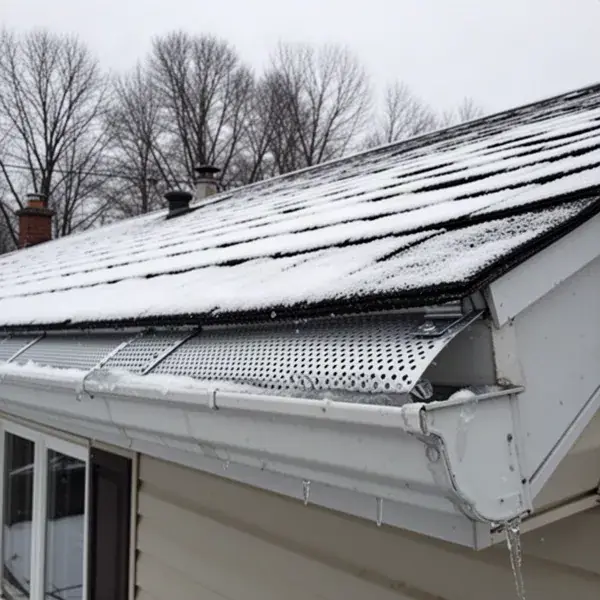
Some guard designs are fastened by nailing through the first course of shingles, or by prying the back edge up under the shingles. Both open holes or break the factory seal strip at the most wind-exposed edge of the roof.
Shingle manufacturers set out how the eave edge must be installed, and damage caused by later alterations is generally not covered by their warranties. We fasten guards to the trough lip and tuck or rest the back edge against the drip edge, so no shingle is lifted or pierced.
If we find the drip edge missing or the starter strip short of the trough, we fix that before installing guards. Water running behind the trough onto the fascia is a roof edge problem that guards would only hide.
Yes, but far less often. Most guarded systems need the surface brushed once a year, usually in late fall, plus a quick look at downspouts and outlets where fine grit collects.
Moss and lichen on north-facing roofs shed organic debris that can coat fine mesh. A roof cleaning every few years reduces that load and keeps the guards draining properly.
If water ever sheets over the front of a guarded trough, the mesh surface is usually coated with pollen or fine silt. A soft brush and a rinse restore it, with no need to remove the guards.
They are worth it if trees overhang your roof and you clean your eavestroughs twice a year or more, or if climbing a two storey ladder is a safety concern. On homes with little tree cover, the cost often outweighs the cleaning it saves.
No, ice dams begin in the attic, where escaping warmth melts the snowpack and the runoff freezes again over the unheated overhang. Some guard designs can collect ice on their surface, though, so mesh type and installed angle matter in our climate.
As a general estimate, installed screens and inserts run roughly $3 to $8 per linear foot, perforated aluminum $8 to $15, and stainless micro-mesh $15 to $35 in the Burlington area. Storeys, roof access and any cleaning or repairs needed first affect the final price, and we confirm the price in writing after seeing the roof.
We will look at your trees, your troughs and your roof edge, then recommend a guard type with a clear written price that includes cleaning and any repairs needed first.
Our workmanship on guard installs is warrantied for one year, and the guards themselves come with the maker's product warranty.
Phones answered 24/7, including emergencies.