TPO Roofing in Burlington, ON for Commercial Buildings
TPO roofing in Burlington has become the go-to single-ply membrane for plazas, offices and warehouses that want a white, reflective roof with welded seams. Fixall Roofing, a roofing contractor based in Burlington, installs, replaces and repairs TPO roof systems on commercial buildings across the city and the nearby Halton and Hamilton area.
TPO, short for thermoplastic polyolefin, is a reinforced sheet whose seams are fused with hot air rather than glued. That welded seam is the main reason owners choose it, and it is also where a rushed installation shows up first.
We work for plaza owners, property managers and warehouse operators who are replacing a tired roof or comparing membrane quotes. Two TPO bids can look alike on paper yet differ in thickness, attachment and insulation, and those details decide how long the roof lasts.
- 15+ years experience
- 700+ jobs completed
- Fully insured + WSIB
- Working at Heights certified
- 1-year labour warranty
- Open 24/7
Commercial TPO Roofing: Installation, Replacement and Repair
Our TPO work covers new roofs, tear-off replacements, recovers over a qualifying existing roof, and repairs to TPO roofs installed by others. Every job ends with probe testing of the seams and a photo record.
We install TPO membranes from established manufacturers such as Carlisle, Holcim Elevate, GAF EverGuard and Johns Manville, chosen by availability, the warranty you need and the accessories the job calls for. We do not mix one manufacturer's membrane with another's flashings, because doing so voids system warranties.
On Burlington's single-storey plazas and steel-deck warehouses, TPO usually goes over polyiso insulation on a steel deck. On concrete-deck offices and condos, it is often fully adhered for a smooth, quiet finish.
Why Building Owners Choose TPO
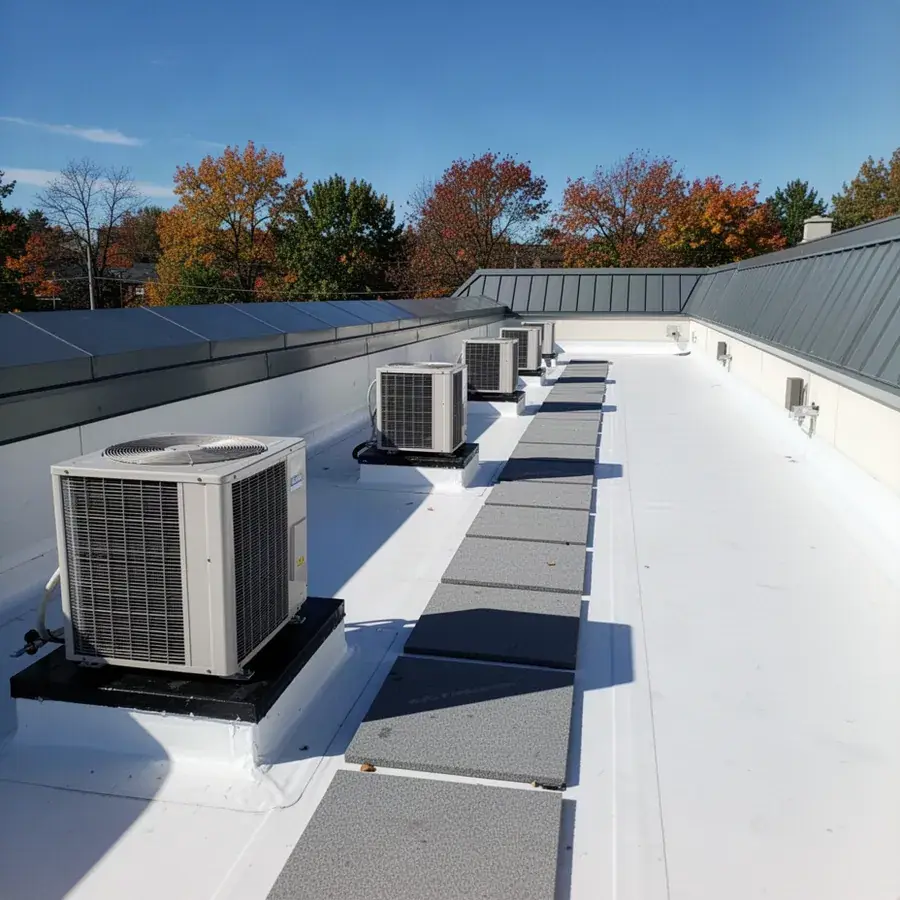
A properly welded TPO seam is as strong as the sheet around it, and it does not rely on adhesive that ages. The white surface reflects most of the summer sun, keeping the roof cooler and reducing load on rooftop air conditioning.
TPO is usually priced below PVC and close to EPDM, and its reinforced scrim gives good puncture and tear resistance under service traffic. That mix of cost and performance is why it has become so common on plaza and warehouse roofs across Ontario.
There are honest trade-offs. Formulations vary between manufacturers, older TPO becomes harder to weld as it weathers, grease from kitchen exhausts attacks it, and the white surface is slick when frost or a light snow is on it.
- Strengths: welded seams, reflective surface, moderate cost, good puncture resistance
- Limits: not for grease or oil exposure, harder to repair once heavily weathered, slippery in frost
- Watch for: thin top ply on 45 mil sheets and flutter on poorly fastened mechanically attached roofs
Attachment Methods
How the membrane is held down matters as much as the membrane itself. Canada's building codes reference CSA A123.21 for the wind uplift resistance of membrane roofing systems, so we choose a tested assembly rated for your building's height and exposure.
| Method | Wind performance | Cost | Best building fit |
|---|---|---|---|
| Mechanically attached | Good when fastener rows follow the uplift design; membrane can flutter | Lowest | Steel-deck warehouses and plazas |
| Fully adhered | Excellent; no flutter and loads spread evenly | Highest; adhesive has temperature limits | Offices, condos, high-wind edges and visible roofs |
| Induction-welded | Very good; plates bonded under the sheet with no seam fasteners | Middle | Steel or wood decks where fewer seams and less flutter matter |
Perimeter and corner zones see the highest uplift, so they get closer fastener spacing or narrower sheets no matter which method is used. An installer who fastens the whole roof to the field pattern is building in a failure.
Membrane Thickness: 45, 60 or 80 Mil
TPO is sold in 45, 60 and 80 mil thicknesses, and the difference is mostly in the top ply above the reinforcing scrim. That top layer is what weathers away over the years, so more of it means a longer life before the scrim is exposed.
45 mil is the minimum and suits budget-driven or short-hold buildings. 60 mil is the common commercial specification and the one we recommend for most Burlington plazas and offices.
80 mil earns its cost on roofs with heavy service traffic, hail exposure or a long ownership horizon, and it is often required for the longest manufacturer warranties. Thicker sheets are stiffer to handle in cold weather, which we plan for in the schedule.
TPO Installation Process
Deck Preparation and Vapour Retarder
The deck is cleaned, damaged steel or wood is replaced and fastener pull-out is checked. On heated buildings, a self-adhered vapour retarder goes down first to keep interior moisture out of the insulation.
Insulation and Cover Board
Polyiso boards, tapered where drainage needs it, are fastened or adhered with staggered joints. A gypsum or high-density cover board protects the insulation and gives the membrane a firm base.
Membrane Layout and Attachment
Sheets are rolled out, relaxed and attached using the method in the uplift design. Laps are oriented so water runs over them, not into them.
Hot-Air Welding
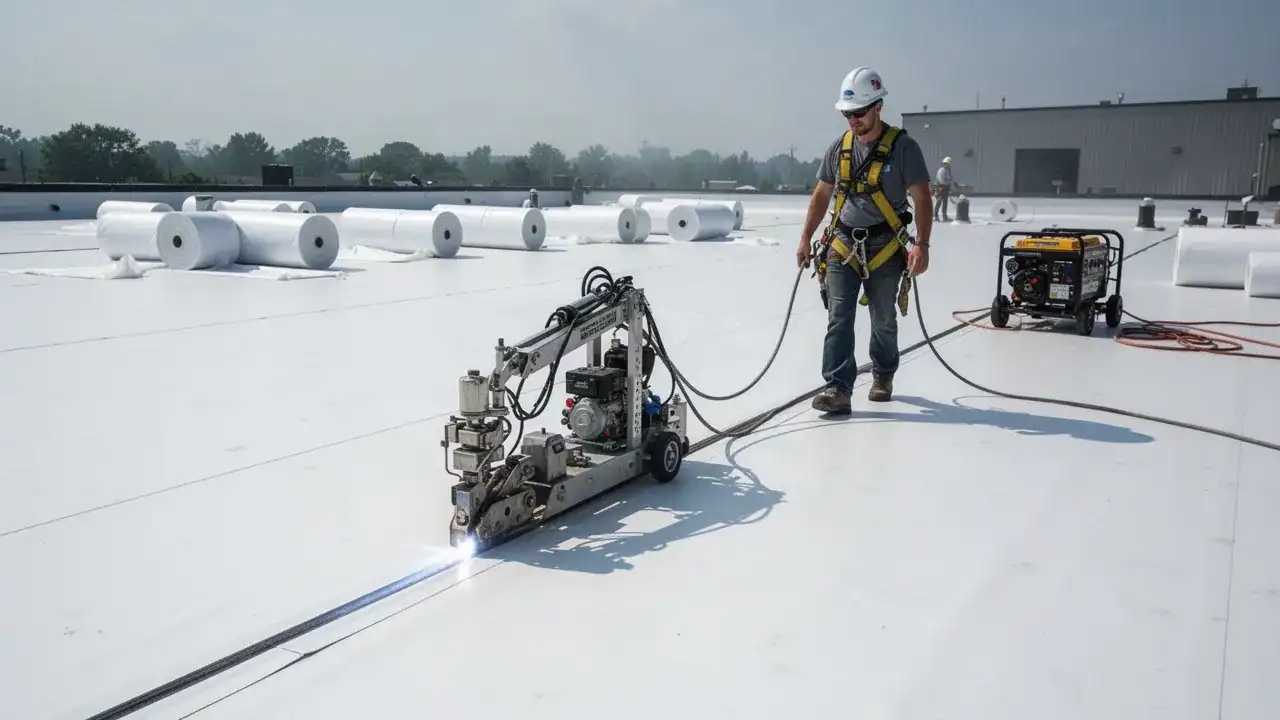
Long field seams are welded with an automatic robotic welder, and details with a hand welder and silicone roller. Test welds are made and peeled at the start of each day and whenever temperature or wind changes, to set heat and speed.
Probe Testing Every Seam
Every seam is checked with a seam probe once it cools, and any gap is rewelded on the spot. Cut samples from the field show weld width when the manufacturer requires them.
Flashing and Final Inspection
Curbs, parapets, drains and pipes are flashed with matching TPO and pre-formed corners and boots. A final walk, manufacturer inspection where required and photo documentation close out the job.
TPO Repairs and Seam Testing
Most TPO repairs are welded patches over punctures or reworked seams found by probing. A patch is cut with rounded corners and extends well past the damage on all sides.
Weathered TPO grows a chalky, oxidized surface that a weld will not stick to. We scrub the repair area with the manufacturer's weathered membrane cleaner and make a test weld before committing to the patch.
Two weld faults account for many seam leaks on TPO roofs. A cold weld looks sealed but peels apart under a probe, while an overheated weld thins and scorches the sheet at the seam edge, and both trace back to skipping the daily test weld.
When the membrane will no longer take a reliable weld or has started to crack, patching becomes a losing game. If the insulation is still dry, roof restoration with a coating approved for TPO may extend its life; if not, replacement is the realistic plan.
TPO vs EPDM vs PVC
All three are single-ply membranes, but they suit different buildings. TPO is the balanced choice: white, welded and moderately priced for most plazas, offices and warehouses.
EPDM roofing is synthetic rubber with taped seams and the longest field history, and it stays flexible in deep cold. It shines on large, simple roofs with few penetrations.
PVC roofing is welded like TPO but resists grease, oils and many chemicals, at a higher price. It is the right answer for restaurants and food plants and usually more than a typical office needs.
TPO Roofing FAQs
How long does a TPO roof last?
A well-installed TPO roof typically lasts 20 to 30 years. Thicker membranes, clean drains, walkway pads at service routes and twice-yearly inspections push it toward the top of that range.
Can TPO go over an existing roof?
Yes, if there is only one existing roof, it is dry and the deck is sound, with a cover board or insulation layer between the old roof and the TPO. If cores find wet insulation or two existing roofs, a tear-off as part of a commercial roof replacement is the right call.
Does TPO handle Ontario winters?
Yes, TPO stays watertight through freeze-thaw cycles, and it can be welded in cold weather with adjusted heat and speed settings. Fully adhered work has more limits because many bonding adhesives need warmer temperatures, so winter jobs may use mechanical or induction-welded attachment instead.
Get a TPO Roofing Quote
Share the address, roof area and current roof type, along with any leaks or reports. We will take cores, recommend the thickness and attachment method that fit the building, and send a written quote.
Phones answered 24/7, including emergencies.
- 1We call you back to confirm the details.
- 2We inspect the roof and attic and take photos.
- 3You get a written scope and price. No pressure.