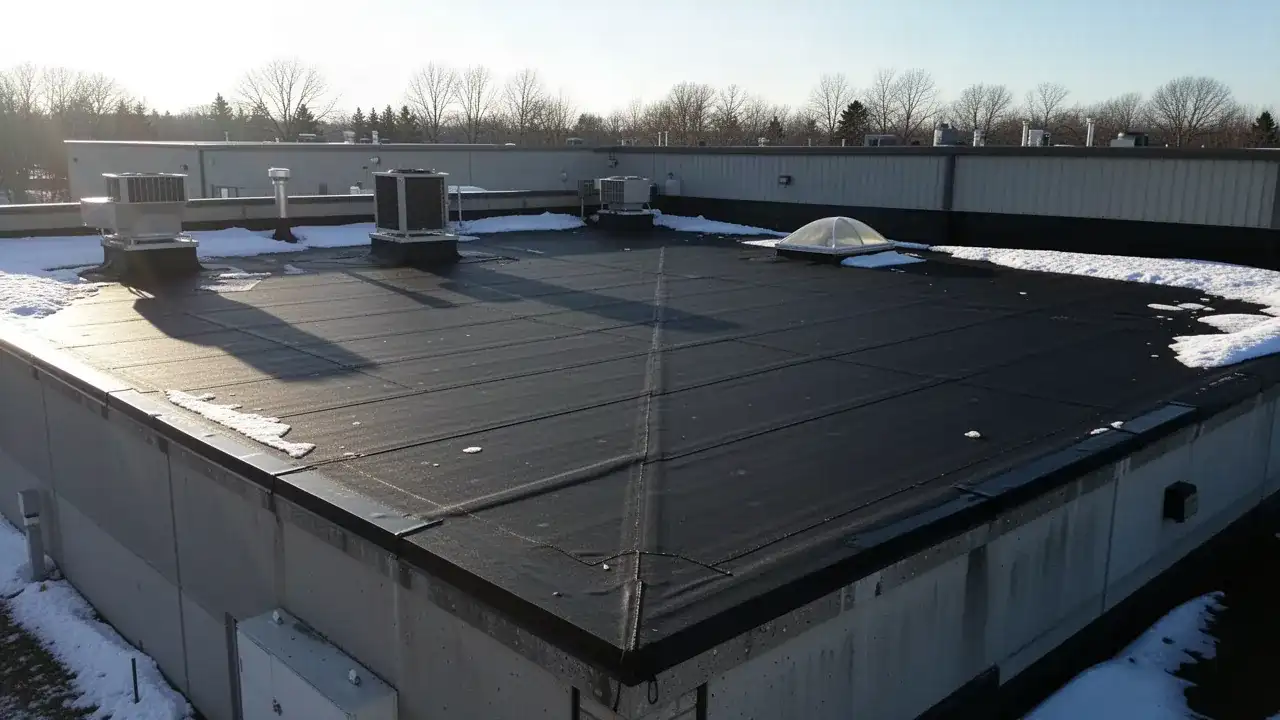
EPDM Rubber Roofing in Burlington, ON
EPDM roofing in Burlington has protected warehouses, schools and plazas for decades, and plenty of those first rubber roofs are now due for repair or replacement. Fixall Roofing installs new EPDM systems, replaces worn ones and repairs seams and flashings on rubber roofs across Burlington and the surrounding Halton and Hamilton area.
Building owners and property managers who call us are usually choosing between three paths: repair the problem spots, re-seam an older roof whose splice adhesive is letting go, or tear off and start over. The deciding factor is often hidden under the rubber, because a roof sitting on wet insulation is rarely worth saving.
- 15+ years experience
- 700+ jobs completed
- Fully insured + WSIB
- Working at Heights certified
- 1-year labour warranty
- Open 24/7
Commercial EPDM Roofing Installation and Repair
Our EPDM work includes new installations, tear-off replacements, repairs, full re-seaming of older roofs and flashing upgrades at curbs, walls and drains. We work with membranes from Carlisle, Holcim Elevate and Johns Manville and keep each roof to a single manufacturer's tapes, primers and accessories.
60 mil is the usual commercial specification, with 90 mil for roofs that see heavy traffic or where a longer warranty is wanted. Reinforced EPDM, which has a polyester scrim, is used in mechanically fastened systems where the sheet has to resist tearing at the fasteners.
When an older rubber roof is replaced, the insulation underneath is often thin by today's standards. Replacing it with tapered polyiso during the same project improves drainage at the drains and brings the roof closer to current energy requirements for little extra mobilization cost.
If you own a home with a low-slope addition, garage or porch roof, our page on residential flat roofs covers the smaller-scale materials and details that suit houses.
Where EPDM Performs Best
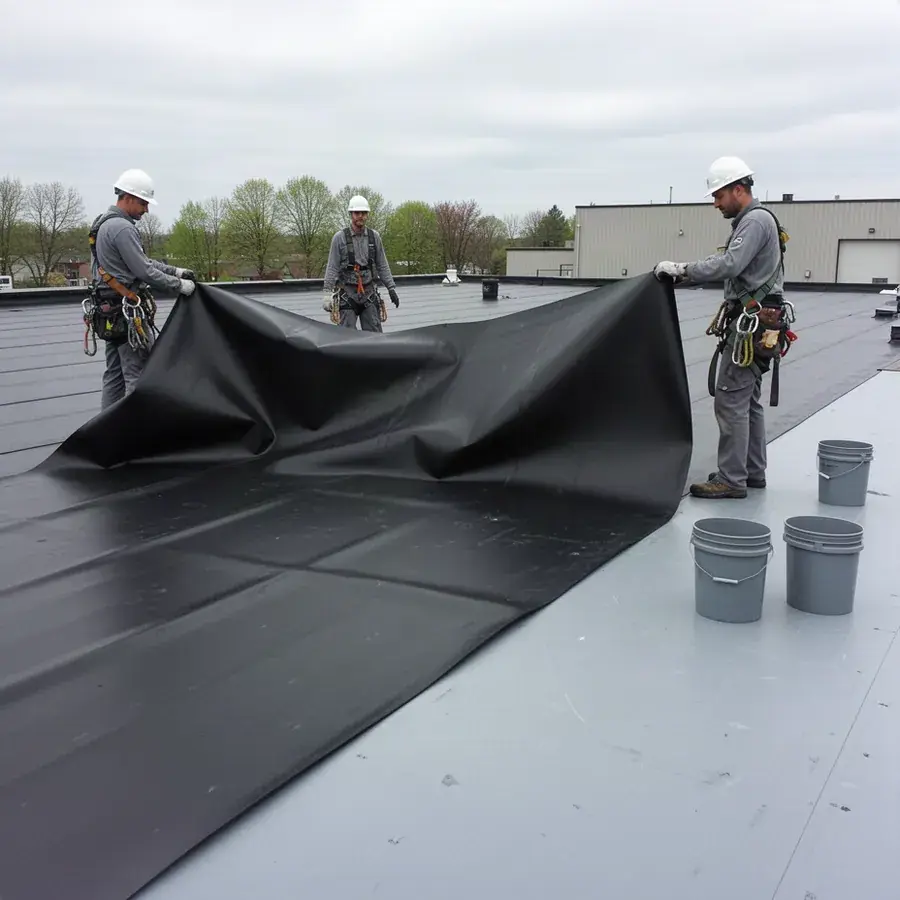
EPDM is at its best on large, low-slope roofs with few penetrations, such as distribution warehouses and older single-storey industrial buildings. Sheets as wide as 50 feet on some products mean a big roof can go down with very few field seams.
Rubber stays flexible far below anything a Burlington winter brings, so it handles freeze-thaw movement and thermal cycling without cracking. It also tolerates hail and flexing decks well, which is why so many older steel buildings in the region still carry it.
It is not the right membrane everywhere. A roof crowded with rooftop units and penetrations means a lot of taped detailing, where welded TPO roofing is often faster and stronger, and any roof exposed to grease or oil needs PVC because petroleum products swell and soften rubber.
- Strong fit: large open roofs, cold exposure, hail-prone areas, budget-conscious owners
- Weaker fit: dense rooftop equipment, kitchen exhausts and oils, owners wanting a white roof at low cost
Installation Methods
EPDM can be held down three ways, and the right one depends on the deck, the structure and the building's wind exposure. The assembly is chosen to meet its tested wind uplift rating under CSA A123.21.
| Method | Weight and wind | Cost | Building fit |
|---|---|---|---|
| Fully adhered | Light; excellent wind resistance with no flutter | Highest | Visible roofs, high-wind edges, irregular shapes |
| Mechanically fastened | Light; good wind resistance with reinforced sheet | Moderate | Steel-deck warehouses and plazas |
| Ballasted | Heavy stone load; limited by building height and exposure | Lowest material cost | Low, sheltered buildings with spare structural capacity |
Fully adhered EPDM is bonded with contact adhesive rolled onto both the membrane and the cover board, then mated once it flashes off. Solvent adhesives carry odour that has to be kept away from air intakes, and low-VOC versions have stricter temperature limits, so cold-season adhered work needs careful scheduling.
Ballasted systems use river stone, commonly around 10 to 12 pounds per square foot, laid over a loose sheet. Before quoting one, we confirm the structure can carry that load and that the building is low and sheltered enough for stone to stay in place, and we never use ballast at roof edges where wind scour is strongest.
Seams, Tapes and Flashing Details
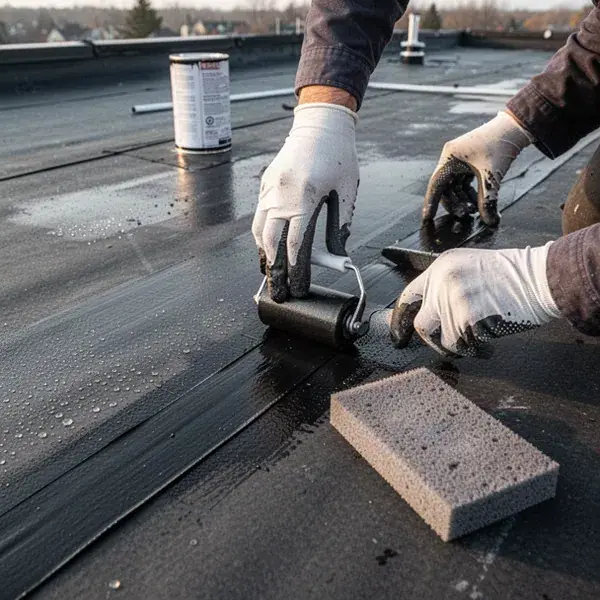
Modern EPDM seams use factory-made seam tape applied over a primed surface and rolled down with a silicone roller. Primer is the step that makes or breaks the seam, and a seam taped over dusty or unprimed rubber will lift within a few seasons.
Many EPDM roofs from the 1980s and early 1990s were seamed with liquid splice adhesive instead of tape. That adhesive dries out and releases with age, which is why older rubber roofs often leak along almost every field seam at once.
At corners, pipes and curbs, we use pre-formed accessories such as inside and outside corners, pipe boots and pourable sealer pockets. Uncured flashing, which can be stretched and shaped, handles odd details where no pre-formed part fits.
Where technicians service rooftop units, we add walkway pads along their route. Rubber is tough, but a dropped panel screw stepped into a seam is one of the most common causes of a slow leak on an otherwise healthy EPDM roof.
EPDM Repairs
Punctures and small tears are fixed with a primed cover patch with rounded corners, extending at least a few inches past the damage. Weathered rubber has a chalky layer that has to be scrubbed off with the manufacturer's cleaner before primer will bond.
A common mistake on rubber roofs is a repair made with asphalt roof cement or a tar-based patch. Petroleum products swell and soften EPDM, so the area around the patch degrades, and we cut those out and rebuild them with proper rubber materials.
On older roofs with failing splice adhesive, re-seaming is often the best value: we open, clean and prime each seam, then cover it with new seam tape. It turns a roof that leaks everywhere into one with years of service left, if the insulation underneath is still dry.
Older non-reinforced EPDM can shrink over time and pull at the perimeter, lifting base flashings off walls and curbs so they bridge the corner. We release the tension, add new membrane at the wall and re-flash, then check how widespread the shrinkage is as part of the commercial roof repair report.
Black vs White EPDM
Black EPDM absorbs heat, which speeds snow melt and helps keep drains open in winter. It is the least expensive and most widely stocked option.
White EPDM is a white top layer laminated to black rubber, and it reflects summer heat much like TPO. It costs more, is less common and shows dirt, so it makes sense mainly on buildings with high cooling loads.
In Burlington's heating-dominated climate, black is a sound default for warehouses and most plazas. Where a white roof is wanted for cooling, we usually compare white EPDM against TPO on price and detailing before recommending one.
EPDM Roofing FAQs
How long does an EPDM roof last?
A properly installed EPDM roof typically lasts 25 to 35 years, and 90 mil sheets on a well-maintained roof can go longer. Seam quality and flashing details usually decide the real lifespan more than the rubber itself.
Can an EPDM roof be coated?
Yes, with a primer made for EPDM and a compatible coating, most often silicone. The roof has to be dry and sound first, which is why EPDM coating restoration always starts with a moisture survey.
Is EPDM the same as rubber roofing?
Yes. EPDM stands for ethylene propylene diene monomer, a synthetic rubber, and it is what most people mean when they talk about a rubber roof.
Get an EPDM Roofing Quote
Tell us the building address, approximate roof size and what is happening on the roof, from open seams to a full replacement. We will inspect, take cores where needed and recommend whether to repair, re-seam or replace, with a written quote.
Phones answered 24/7, including emergencies.
- 1We call you back to confirm the details.
- 2We inspect the roof and attic and take photos.
- 3You get a written scope and price. No pressure.